Why Switching Fund Administrators Is Hard, Why It Shouldn't Be, And Why Soon It Won't Be
April 01, 2026

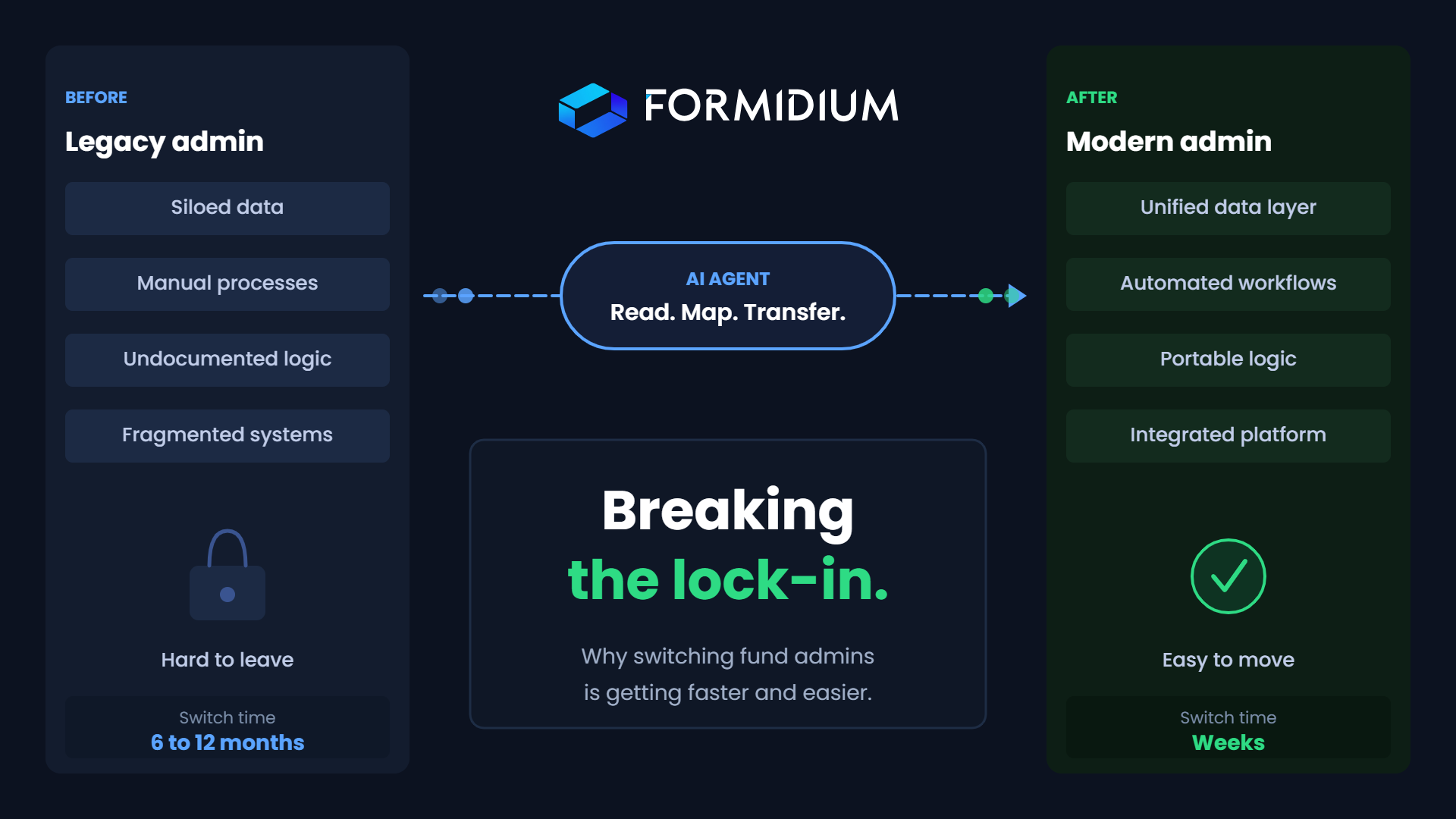
Everyone in fund administration knows the quiet truth: switching administrators is painful. Not because the work is impossible, but because the industry was built to make it feel that way.
Managers stay with the wrong administrator for years. Not out of satisfaction, but out of inertia. The switching costs feel enormous. The disruption feels unknowable. And the implicit message from the industry has always been: better the devil you know.
That calculus is changing. Managers who understand why will move sooner, and more cleanly, than they expect.
Why Switching Feels So Hard
The difficulty of switching administrators is real, but it's worth understanding where the friction actually comes from. Most of it is not inherent to the work. It's a byproduct of how administrators are built.
Data is trapped, not portable. Many administrators operate on third-party accounting platforms or proprietary systems designed without migration in mind. Historical data (journal entries, investor records, allocation histories, audit trails) often lives in formats that don't export cleanly. When a manager asks for their own data, the response is frequently incomplete, delayed, or delivered in formats that require significant manual reconstruction.
This is not an accident. When your data is hard to extract, you're harder to leave.
Processes are undocumented. In many administrator relationships, institutional knowledge lives in the heads of the people doing the work, not in systems. How fees are calculated, how allocations are handled, how exceptions are resolved. These workflows are often informal and person-dependent. When a manager considers switching, there's a legitimate fear that critical logic will be lost in translation.
Timing creates pressure. Transitions are easiest at fiscal year-end or between audit cycles, which creates narrow windows. Administrators know this. The implicit message is always: not now, maybe next year. And next year, the same logic applies.
Relationships create gravity. Managers build personal relationships with their accounting teams. Those relationships carry real value: familiarity, trust, institutional memory. Walking away from people you've worked with for years feels like a loss, even when the underlying service no longer meets your needs.
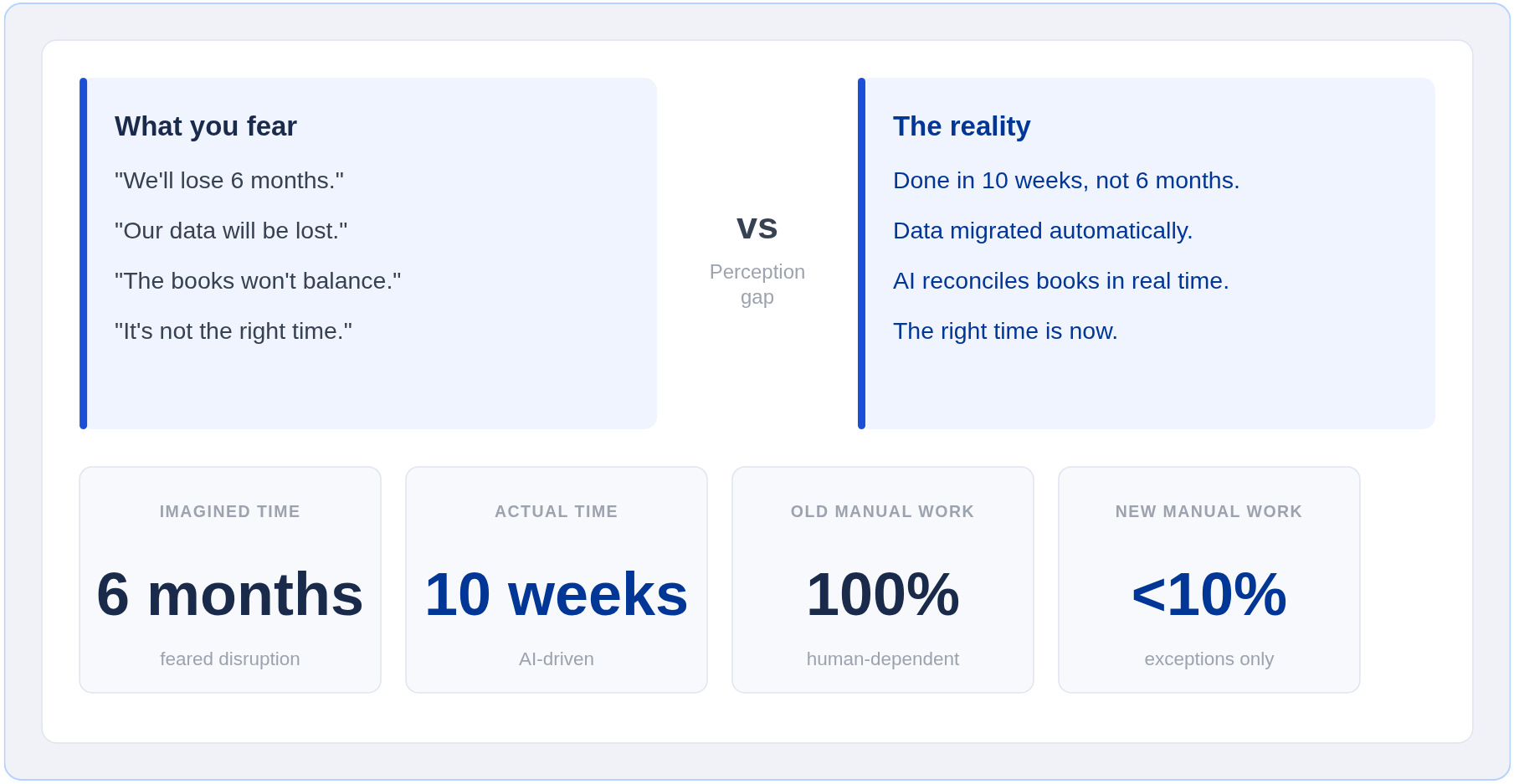
The switching cost is assumed to be enormous. Perhaps the most powerful friction of all is simply the perception that switching will be massively disruptive. Managers imagine months of parallel operations, duplicated costs, audit risk, and investor confusion. That perception keeps managers in place long after the rational case for moving has become clear.
None of this is unique to fund administration. These are classic characteristics of high-switching-cost industries. But the fact that the friction is structural rather than inevitable is precisely the point.
Why It Should Be Easier Than You Think
The barriers to switching are real, but they are not fixed. They are artifacts of a specific way of building an administrator. And that way is becoming obsolete.
Technology changes the data problem. When an administrator owns its accounting system and operates on a unified architecture, where onboarding, accounting, reporting, and compliance share a single data layer, data becomes structured, portable, and extractable by design. Migration isn't an archaeological excavation. It's a data transfer.
The administrators that make switching hardest are, not coincidentally, the ones most dependent on fragmented systems and manual processes. The ones that make it easiest are the ones whose technology was designed to be the single source of truth from day one.
AI agents change the reconstruction problem. Historically, one of the most painful parts of a transition was reconstructing the logic behind how a fund's books were maintained. The allocation methodologies, fee structures, exception handling, and reporting conventions that accumulated over years of operation.
AI agents are beginning to change that dynamic. These aren't chatbots or dashboard assistants. Agents are autonomous systems that can ingest a fund's historical data, map its accounting logic, validate its allocation methodologies, and reconstruct its operational workflows. Tasks that previously required months of manual analysis by senior accountants on both sides of the transition.
When accounting logic is embedded in systems rather than in people's heads, agents can read it, transfer it, and validate it. The "how" of fund accounting becomes documented in code and structured rules, not in tribal knowledge. An agent can parse an allocation waterfall, compare it against the new system's configuration, and flag discrepancies in hours, not weeks.
This isn't theoretical. It's already happening.
At Formidium, we built an onboarding platform designed to eliminate the friction that makes transitions feel overwhelming. There are no endless email chains requesting documents. No ambiguity about what's needed. Managers and investors upload through a clear, guided portal, and AI agents read the submitted documents, extract the relevant data, and pre-fill fields automatically. What used to require weeks of back-and-forth and manual data entry now happens in a fraction of the time, with fewer errors and less burden on the manager.
That's not a roadmap item. It's live, and it's already reshaping how transitions work in practice.
This doesn't eliminate the need for careful transition planning. But it dramatically reduces the risk that critical logic will be lost or misinterpreted during a move.
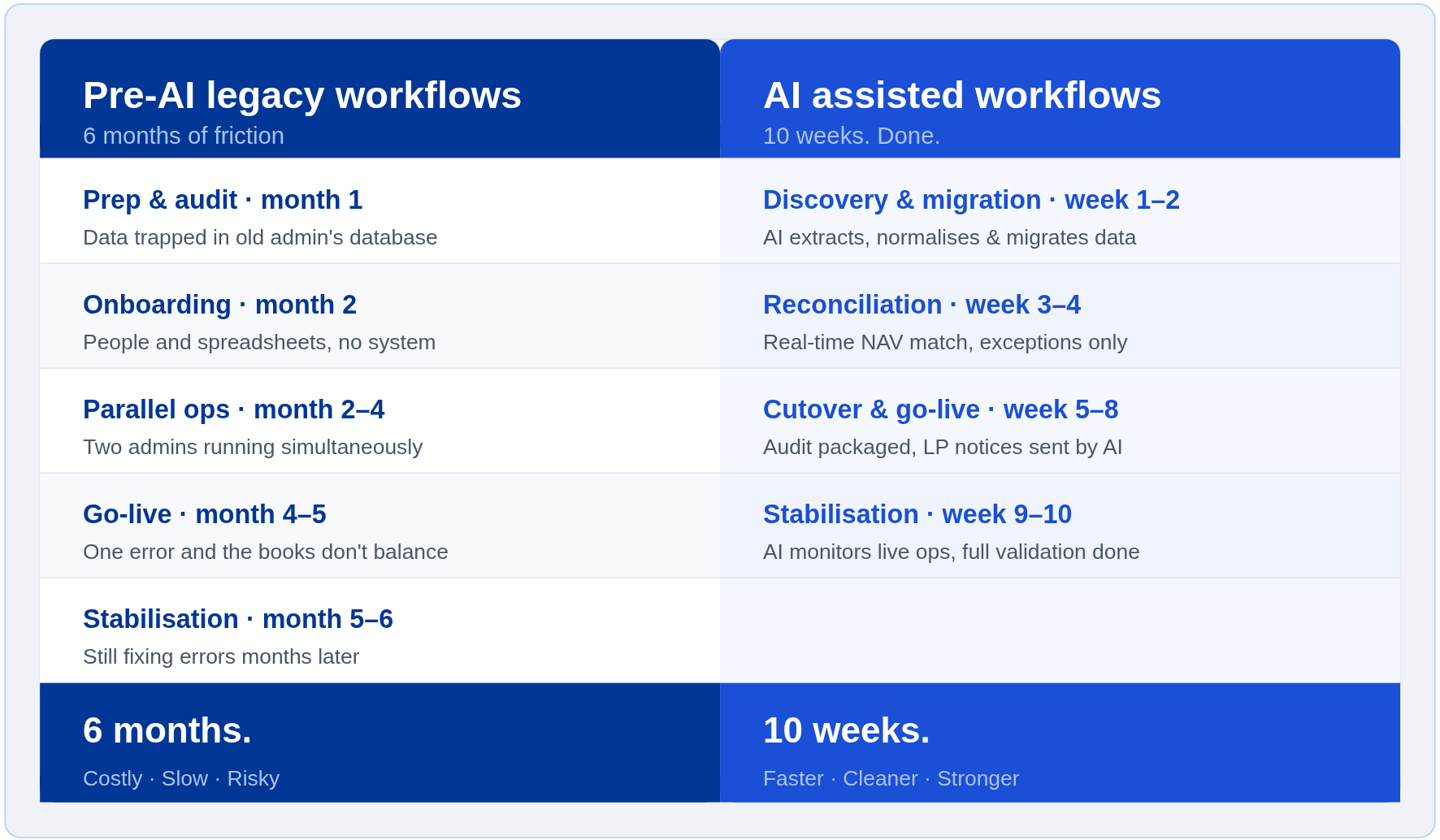
Parallel operations are shorter than they used to be. In a traditional transition, parallel operations (running both the old and new administrator simultaneously) could last six months or longer. That timeline assumed manual reconstruction of books, re-keying of investor data, and iterative reconciliation between two sets of records.
When the receiving administrator operates on an integrated, automated platform with AI agents handling data ingestion and validation, that timeline compresses. Agents can import structured data, reconcile balances across systems, and surface exceptions for human review, replacing the line-by-line manual comparison that used to define parallel operations. What used to take two quarters can increasingly be accomplished in weeks.
The audit trail travels with you. One of the deepest fears in switching is losing audit defensibility: the ability to demonstrate to auditors, investors, and regulators exactly how the books were maintained during the transition period. Administrators built on owned, integrated systems can produce complete, time-stamped audit trails that survive a transition intact. The historical record doesn't disappear. It transfers.
How to Switch: A Practical Framework
For managers who've decided the cost of staying exceeds the cost of moving, the transition doesn't have to be chaotic. It requires planning, but it's more manageable than the industry wants you to believe.
Start with your data, not your frustrations. Before initiating any conversation with a new administrator, understand what you have. Request a full data export from your current administrator: general ledger, investor records, historical allocations, journal entries, and supporting documents. The completeness and speed of that response will tell you a great deal about the relationship you're leaving.
Evaluate architecture before evaluating people. When assessing a new administrator, the most important question isn't who will be on your team. It's how their system is built. Does the administrator own its accounting platform? Is onboarding integrated with the ledger? Are allocations rule-driven? Can you access the general ledger directly? These structural questions determine whether the transition will be a one-time friction event or the beginning of a different kind of problem.
Define the transition scope clearly. Not everything needs to move at once. A well-planned transition distinguishes between what must be operational on day one (current-period accounting, investor reporting, regulatory compliance) and what can be migrated over a defined timeline (historical data, legacy reporting, archived records). Scoping prevents the transition from becoming an open-ended project.
Negotiate transition support from both sides. The outgoing administrator has an obligation to support data extraction and parallel operations during the transition period. The incoming administrator should have a defined onboarding methodology, not a generic checklist, but a structured process for ingesting data, validating balances, and confirming accounting logic. If either side can't articulate how they handle transitions, that's a signal.
Communicate proactively with investors and auditors. Transitions create anxiety not because they're inherently risky, but because they're often poorly communicated. Investors and auditors respond well to clear timelines, defined responsibilities, and evidence that the incoming administrator has a credible technology and operational foundation. Silence is what creates concern.
Set a hard cutover date and hold it. Parallel operations should have a defined end point. Open-ended parallel runs are expensive, create confusion, and signal that the transition isn't being managed with discipline. A firm cutover date, agreed to by both administrators, the manager, and the auditor, forces accountability and keeps the process on track.
Why Soon It Won't Be Hard at All
Everything discussed above describes where the industry is today. A transition period where technology-forward administrators have made switching manageable, but the legacy infrastructure at most firms still creates real friction.
That friction has an expiration date.
The trajectory of AI, and specifically AI agents, in fund operations points toward a near-term future where the barriers to switching don't just shrink. They functionally disappear.
Agents make accounting logic fully portable. Today, transferring a fund's accounting methodology between administrators requires senior professionals on both sides to manually document, interpret, and rebuild logic. As AI agents mature, that process inverts. An agent operating within a structured accounting system can export a fund's complete operational logic (allocation rules, fee calculations, reconciliation tolerances, exception handling protocols) as transferable configuration. A fund's accounting methodology will move between platforms the way a codebase moves between environments: versioned, validated, and intact.
Agent-to-agent communication eliminates reconstruction. The most transformative shift won't be agents working within a single administrator's system. It will be agents communicating across systems. When an outgoing administrator's agent can transfer structured data, logic, and audit history directly to an incoming administrator's agent, with automated validation at every step, the manual reconstruction that defines today's transitions becomes unnecessary. Data standardization accelerates this. As the industry moves toward common formats for investor records, transaction histories, and reporting outputs, agent-driven migration will require hours, not months.
Transition itself becomes an automated workflow. AI agents don't just make the destination better. They make the journey shorter. Agents can reconcile historical books against imported data in real time, flag anomalies that would have taken weeks of manual review, and produce validation reports that give auditors confidence in the cutover. Parallel operations that currently run for months will compress to days, and eventually become unnecessary altogether as agent-driven migration achieves sufficient reliability.
The lock-in model becomes competitively untenable. As agents reduce switching costs toward zero, administrators who rely on friction to retain clients will face a structural problem. Managers will leave, not in a trickle but in waves, once the perceived cost of moving drops below the ongoing cost of tolerating subpar service. Administrators that haven't invested in making their own platforms welcoming to inbound transitions will find themselves losing clients to those that have. The market will reward portability, and penalize captivity.
This isn't a ten-year prediction. The underlying technologies (structured accounting engines, AI-driven data normalization, automated reconciliation) already exist. What's changing is adoption. And adoption, once it reaches a tipping point, moves fast.
Some of this is already here. Digital onboarding portals have already eliminated much of the paperwork and back-and-forth that made transitions feel unbearable even five years ago. AI agents are extending that same principle deeper into the accounting layer. The shift from "painful but survivable" to "straightforward and fast" isn't a future state. It's a 2026 reality, and it will only accelerate from here.
The fund administrators that understand this are already building for a world where clients stay because the service is excellent, not because leaving is painful.
The Real Cost of Not Switching
Managers often frame the switching decision as a cost-benefit analysis: is the pain of moving worth the improvement in service?
That framing understates the cost of staying.
An administrator that lacks transparency, relies on manual processes, and can't scale with your fund doesn't just underperform today. It compounds operational risk over time. Every month spent with the wrong administrator is a month where errors are more likely, audit exposure is higher, investor confidence is less supported, and the manager's own time is consumed by operational friction that should have been eliminated by systems.
The cost of switching is finite and front-loaded. The cost of staying with the wrong administrator is ongoing and cumulative.
In an environment where AI agents are reshaping the economics of fund operations, managers who delay switching aren't just accepting subpar service. They're falling behind a curve that accelerates with every quarter.
Final Thought
The fund administration industry has benefited for years from the perception that switching is prohibitively difficult. That perception was never entirely wrong, but it was always more a reflection of how administrators were built than of any inherent complexity in the work itself.
Technology is dismantling those barriers. AI agents are making accounting logic portable, data structured, and transitions faster. The managers who recognize this early won't just find a better administrator. They'll stop subsidizing the inefficiencies of the one they should have left behind.
The hardest part of switching fund administrators has never been the transition itself.
It's deciding you deserve better infrastructure than what you're currently paying for.
About the Author
Shalin Madan is co-founder of Formidium and former hedge fund manager with 25 years in alternative investments and fund administration. At Formidium, proprietary technology supports over $34 billion in AUA, delivering institutional-grade capabilities with boutique-level service for real estate, private equity, venture capital, and digital asset funds.