Rethinking Automation in Fund Administration: Why Exception-Driven Architecture Matters
March 22, 2026

A few years ago, automation in fund administration meant something straightforward: make existing workflows move faster. Speed up calculations. Reduce manual data entry. Shorten cycle times.
It improved efficiency. But it did not fundamentally change how the work was structured.
Processes were still review-heavy. Systems were still connected through file exchanges. Teams still spent significant time validating outcomes that were, in most cases, entirely deterministic.
The real shift began when the question changed.
Instead of asking, "How do we automate this step?" the more important question became:
Why does this step require review at all?
At Formidium, that question became foundational.
Moving Beyond Review-Driven Models
Traditional fund administration relies on review as a default mechanism for control. Even predictable workflows pause for manual validation. Over time, that design introduces friction — repeated touchpoints, reconciliation loops, and operational strain as data volumes increase.
Formidium chose a different direction: building around an exception-driven model.
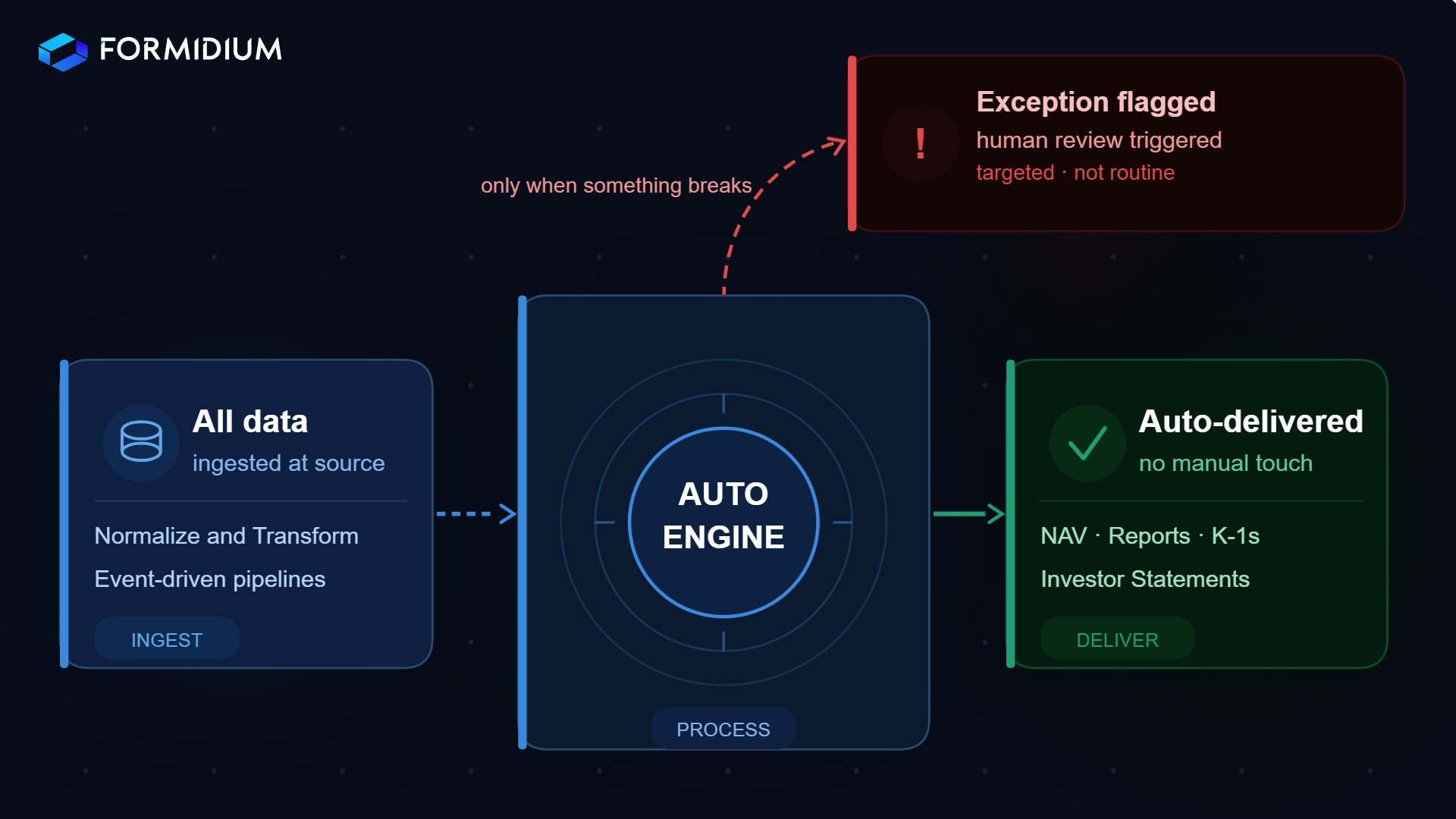
In this model, deterministic workflows run uninterrupted. Human attention is applied only when something genuinely breaks. Instead of reviewing everything, operators focus on meaningful exceptions.
When we speak about "zero manual error," it does not imply removing oversight. It means removing manual touchpoints from predictable processes and ensuring that review is reserved for areas requiring judgment.
That distinction reshapes scalability and reliability in ways incremental automation never could.
How the Philosophy Becomes Practical
An exception-driven mindset only matters if it translates into real workflows.
In investor onboarding, Formidium embedded third-party identity, sanctions, and risk checks directly into the onboarding flow. Verification runs in real time, and only true exceptions surface to compliance. The process becomes smoother for investors and more precise for operators.
Market data ingestion was redesigned to flow through event-driven pipelines rather than batch dependencies. Data from multiple exchanges and brokers moves continuously, significantly reducing availability delays and eliminating timing bottlenecks.
Multi-source normalization now happens at ingestion. By structuring data before reconciliation begins, what was once a multi-stage validation exercise moves closer to a single-step process.
The NAV workflow follows the same architectural logic. From data ingestion through calculation, controls are embedded within the workflow. Exceptions are identified early, reducing downstream corrections and minimizing manual intervention.
Even document distribution reflects this approach. Investor statements, K-1s, and reports are automatically routed based on investor-level preferences and securely delivered to designated advisors. Manual coordination is removed without sacrificing control.
These changes are not surface enhancements. They reflect deliberate architectural design.
The Architecture Behind the Model
To make exception-driven operations sustainable, Formidium built its platform around three structural principles.
An exception-first operating framework ensures workflows continue unless a genuine variance is detected. Automated break detection and routing mean teams focus only on issues that warrant investigation.
An API-first integration model enables tighter system connectivity and higher straight-through processing. Reducing file-based exchanges lowers manual intervention points and improves continuity across workflows.
A cloud-native foundation allows compute and processing capacity to scale independently as data volumes grow. As complexity increases across asset classes and jurisdictions, performance remains consistent without introducing operational strain.
Automation, in this context, is not an overlay. It is embedded into the core.
Why This Matters
Fund structures are becoming more complex, not less. Multi-asset strategies, cross-border reporting, and evolving regulatory demands are redefining operational expectations.
Review-driven models struggle under that complexity because each incremental layer adds more manual validation.
Exception-driven architecture scales differently. Deterministic processes move without interruption. Oversight becomes targeted. Control strengthens as volumes increase rather than weakening under pressure.
At Formidium, automation is not framed as a feature. It is treated as a design decision — one that determines whether complexity compounds or simplifies over time.
The conversation around automation often centers on how many processes are automated. The more meaningful question is whether automation reshapes the operating model itself.
In the long term, architecture determines durability.
See It in Practice
Formidium's team works directly with fund administrators and operations leaders to assess where exception-driven design can have the most immediate impact. If you're ready to explore what that looks like for your organization, we'd welcome the conversation.
Questions or want to see the platform in action? Contact our team or request a demo at formidium.com.
About Author
Rakesh Kumar is the Chief Technology Officer at Formidium, a global fintech firm specializing in fund administration and SaaS solutions for alternative investment managers. With extensive experience in building scalable platforms and leading high-performing technology teams, he drives innovation across areas such as AI, Blockchain, data engineering, and cloud infrastructure. Rakesh is passionate about leveraging emerging technologies to enhance operational efficiency and transform financial services.